






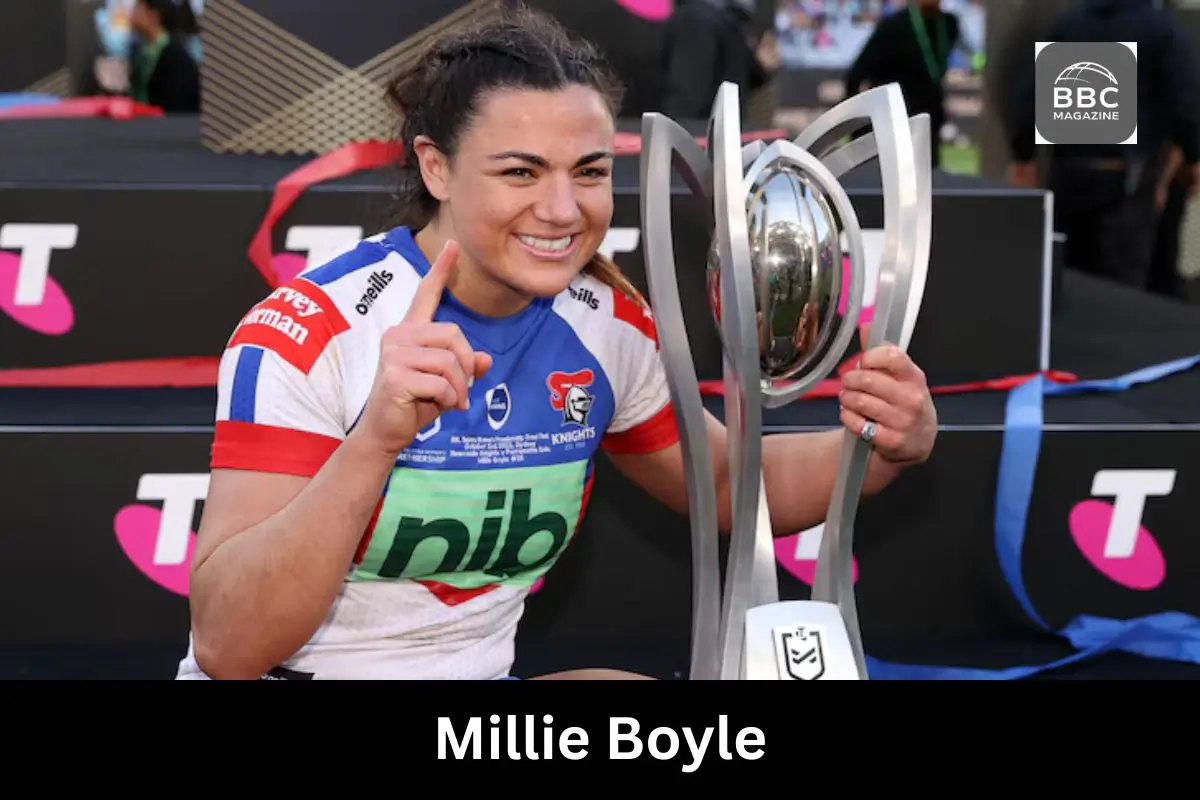
Millie Boyle, now known as Millie Elliott, has built one of the most significant careers in Australian women’s rugby across the modern era. She has played at the top level in rugby union and rugby league, won major club titles, earned representative honours, and collected individual recognition in a period when women’s rugby was moving from semi-professional routines to a more structured, high-performance environment.
Her story works on two levels at once. On the surface, it ‘s a sporting biography defined by big games, big moments and sustained output in the middle of the field. At a deeper level, it is also a case study in how Australian women’s rugby has changed: how pathways have widened, how professionalism has accelerated, and how athletes have had to make career-defining decisions in real time as the landscape shifted around them.
Early Life in Cobargo and the Shape of a Sporting Upbringing
Millie Boyle was born on 19 May 1998 in Cobargo, on the far south coast of New South Wales. Regional Australia produces elite athletes across many sports, but the route is rarely straightforward. Training environments are often less resourced than metropolitan programmes, travel can be part of weekly life, and progress depends heavily on personal commitment, local coaches and the ability to stand out repeatedly against older or stronger competition.
Cobargo’s rugby culture and broader sporting community provided a setting where physicality and effort mattered. For a young forward, those foundations are often decisive. The habits that later define elite middle players—showing up every session, repeating contact efforts, backing up after tackles, and staying composed when fatigued—are frequently built in environments where you cannot hide behind reputation.
As she moved through junior levels, Boyle’s profile grew quickly. She developed as a forward with a strong engine and a natural willingness to work through the toughest areas of the game. Even without relying on flash, she stood out through the kind of traits that selectors tend to value in high-performance pathways: repeatable effort, consistent physical intent, and the ability to keep playing well when a match becomes a grind rather than a showcase.
Family Background and a Home Life Built Around Rugby
Family history reinforced Millie Boyle’s rugby grounding. Rugby league, in particular, has been part of her family story for years. Her father, Adam Boyle, and her uncle, Jason Boyle, played rugby league at senior levels, and her brother, Morgan Boyle, progressed to the NRL. That context matters because it shapes a player’s relationship with the sport.
In families like this, rugby isn’t a weekend hobby. It is a routine, a language, and a set of standards. It teaches young athletes that ability alone is never enough—preparation, recovery, nutrition, mental resilience and the willingness to keep improving are what sustain careers. It also creates a sharper understanding of what professional sport actually demands: not just big moments, but the quieter discipline that sits behind them.
That background doesn’t guarantee success, but it often shortens the learning curve. It can accelerate maturity, especially when a young athlete enters senior systems early and must adjust quickly to higher expectations.
The Junior Pathways and Step Into Elite Systems have significantly expanded in Australian women’s rugby.
Australian women’s rugby pathways have expanded dramatically in recent years, but during Boyle’s early development they were still emerging compared to the men’s system. That means many players of her generation progressed through a mix of community competition, representative selection and high-performance training blocks that required flexibility and persistence.
What matters in Boyle’s case is that she moved into elite environments early. She did not arrive as a late developer; she broke into national selection conversations while still young. For a forward, that typically reflects more than size. It suggests game sense, defensive work, and a mindset suited to high-level training loads.
Even in the absence of an over-documented junior “brand”, her early trajectory points to a player who was consistently chosen because coaches trusted her in demanding roles—roles where the job is to do the hard work that lets others play.
Rugby Union Breakthrough and the Wallaroos Era
Boyle’s first major national chapter came through rugby union. As a flanker, she operated in a position defined by work rate and physical contest: tackling volume, breakdown involvement, defensive organisation, and the ability to cover large sections of the field without losing shape.
Her rise culminated in selection for the Australian Wallaroos, and she was named in the 2017 Women’s Rugby World Cup squad. Making a World Cup squad at that stage of her life placed her in rare territory and confirmed her as a genuine top-tier prospect in Australian women’s rugby.
International rugby union is often unforgiving for young forwards. The pace of collisions, the consistency of opposition structures, and the relentless nature of the breakdown make it difficult to “survive” on raw athleticism alone. Forwards who last at that level typically do so because they can make sound decisions under fatigue and maintain discipline when pressure rises. Boyle’s presence in that environment mattered because it gave her an elite baseline—technically, physically and mentally—that later translated effectively into rugby league.
It is also important in understanding her later code switch. She did not move into the league as an untested athlete. She arrived with experience of elite standards and international preparation.
The Career Crossroads: Why the Code Switch Mattered
In 2019, Boyle shifted from rugby union to rugby league, and the timing tells much of the story. The NRLW was expanding in profile and structure, and the women’s game in the league was beginning to offer clearer professional direction than it had previously. For many athletes, the decision was not simply about preference between codes. It was also about opportunity, stability, and where the strongest pathway appeared to be forming.
Switching codes is not a cosmetic move. In rugby league, the middle third is a different kind of contest. Defensive lines are tighter and more repetitive. Carriers are more direct. The rhythm of involvement is constant, and performance is judged heavily through the “unseen” metrics: effort plays, rapid play-the-balls, defensive reliability, and the ability to maintain intensity over repeated sets.
Boyle’s game translated naturally. Her union background gave her a strong understanding of contact and defensive systems, and her physical style suited the league middle. Over time, she became the sort of forward coaches build systems around: not necessarily the most talked-about player every week, but one whose presence makes the rest of the team more stable.
NRLW Club Career and the Value of Adaptability
Boyle’s NRLW journey includes key periods at major clubs, most notably the Brisbane Broncos, the Newcastle Knights, and later the Sydney Roosters. What stands out is not only the calibre of the clubs but also the way she contributed in different environments.
She worked in a system at Brisbane that established early benchmarks for the tournament. Strong NRLW teams rely on reliable middle forwards who can defend repeatedly, absorb pressure and keep their sides in the fight when matches tighten. Boyle’s style suited that need. She was not merely an add-on to the performance; rather, she played a crucial role in enabling the functioning of attacking structures.
Her time with Newcastle added another dimension. A club building its identity needs senior forwards who can handle big moments and maintain consistency when a season becomes intense. At this level, success in the Premiership is rarely based solely on highlights. It is built on the ability to win the middle and survive long defensive sequences without conceding momentum. Boyle’s career success across clubs reflects her ability to do that work repeatedly, regardless of jersey.
Her later move to the Roosters placed her into another high-profile environment, where experience and leadership carry weight. Teams striving for contention expect senior middle players to have an equal impact on training standards and match-day outcomes. Boyle’s standing in the competition meant she arrived not just as a reference point for what elite preparation looks like.
Representative Football: Origin and the Jillaroos Standard
Representative selection has been central to Boyle’s league identity. She has played State of Origin for New South Wales, a contest that remains the sharpest proving ground in Australian women’s rugby league. Origin football compresses time and space. It exposes defensive weaknesses quickly and demands composure in the middle. For forwards, it is a test of endurance, decision-making, and the ability to keep turning up after fatigue has set in.
She has also represented Australia with the Jillaroos, a level that demands not just talent but the ability to adapt to international intensity and carry leadership responsibility. These selections reinforce the way she is viewed within the sport: a forward trusted to do the difficult, high-accountability work that wins matches at the top level.
It is also where her dual-code career becomes particularly meaningful. Not many athletes have carried elite credibility across both rugby union and rugby league at the national level. Doing so requires a foundation of professionalism that goes beyond code-specific skills.
Style of Play: What Makes Her Effective
Boyle’s impact is often best understood through the role she plays rather than the headlines she generates. She has been recognised as a player whose value shows in the hardest areas of the field: defensive consistency, contact dominance, and the ability to maintain pace across long minutes.
In rugby league terms, she fits the profile of a middle forward who improves her side’s control. She helps establish field position through strong carries and supports the team’s defence through repeated tackles. This kind of player often becomes the backbone of finals campaigns, because finals are typically decided by who wins the middle and who stays disciplined when fatigue rises.
Her presence also influences teammates. Elite forwards set standards through their willingness to do difficult work repeatedly. In a competition like the NRLW—where professionalism and performance culture have been accelerating—players who model those standards become valuable beyond their stats.
Awards and Recognition: What the Dally M Represents
Boyle’s individual recognition reached a major peak when she received the NRLW Dally M Medal, awarded to the competition’s top player across a season. Rugby league tends to reward athletes who combine performance with consistency, as the season is short and each match holds significant weight.
For a forward to earn that recognition is significant. It reflects an impact that cannot be dismissed as a single performance spike. It indicates a season where she repeatedly shaped matches through work in the middle: carrying, defending, setting tone, and influencing momentum.
Awards like this also shape legacy. They place an athlete into a historical conversation about who defined the competition at key stages of its growth.
Premiership Success and the Meaning of Winning With Different Clubs
Boyle has been part of premiership-winning campaigns in the NRLW, including titles with the Brisbane Broncos and the Newcastle Knights. Winning premierships is never a one-player story, but middle forwards often decide whether a team holds together under finals pressure.
Finals football compresses margins. It makes every defensive lapse costly and every soft carry noticeable. It rewards teams whose middles can keep pace and protect the ruck. Boyle’s premiership record reflects her ability to perform under those conditions.
Winning with different clubs adds another layer, because it suggests she was not merely benefiting from a single system. It suggests she can adapt to different coaching philosophies, different forward rotations and different team cultures—an underrated indicator of genuine elite value.
Managing Physical Demands and Longevity in the Middle
The middle of rugby league is unforgiving. It is a role built on collision, repetition and resilience. Sustaining a career in that space requires more than strength; it requires durable habits and the ability to manage loads across seasons.
While athlete profiles often emphasise highlights, consistency typically defines forward careers. Preparation, recovery, and disciplined physical management are key factors in maintaining effectiveness over time. Boyle’s longevity at the top level, across clubs and representative teams, points to strong professional habits. Even when she is not dominating headlines, she has remained a figure coaches want in their team, and that usually reflects reliability that is difficult to replace.
Personal Life, Marriage and the Conversation Around Motherhood in Sport
Millie Boyle is married and now appears in rugby league contexts as Millie Elliott. In 2025, her pregnancy became a significant point of discussion across Australian sports reporting, not as celebrity noise, but as part of a broader conversation about women’s professional sport.
Pregnancy and return-to-play planning are central issues in leagues where professionalism is still evolving. They touch everything, from training structures and medical support to contract security, role clarity, and the realities of balancing high-performance sport with family life. Boyle’s circumstances, as a high-profile athlete whose career has relied heavily on physical work and elite standards, brought these issues to the forefront.
That chapter, in many ways, embodies the broader narrative of her career. She has repeatedly been present at moments when women’s rugby in Australia has had to adapt and grow—whether through code shifts, expanding professionalism, or the practical realities of athletes’ lives beyond the field.
Age and Career Phase
Born in 1998, Boyle is in a phase of her career where she combines physical prime with profound experience. In women’s rugby, where pathways have been evolving quickly, that combination is influential. Players with her background become reference points for the next generation. They shape standards, set expectations, and quietly teach younger teammates what top-level professionalism requires.
This phenomenon is especially true for forwards. Skill development matters, but so does mindset: how to prepare, how to recover, how to compete through fatigue, and how to keep performing when the game becomes difficult.
Net Worth and the Financial Reality of the Women’s Rugby League
It is important to place financial discussion in the context of the NRLW. The women’s game has been improving in pay and support, but it does not yet operate under the same financial conditions as the men’s competition. Earnings are generally built through a mix of club salary, representative payments, and limited commercial opportunities.
With that context in mind, the requested estimate is as follows.
Estimated net worth (2025): AUD $350,000–$700,000.
This range aligns with the financial realities of elite NRLW athletes who have achieved sustained success, representative selection and significant individual recognition over multiple seasons.
Media Profile and Public Presence: A Different Kind of Star
Performance and achievement, rather than constant media visibility, have largely driven Boyle’s public profile. In Australian sport, some athletes build their presence through personality-driven publicity. Others become known for substance: the kind of player whose name appears whenever conversations turn to standards, leadership, and winning football.
Boyle belongs to the second category. Her recognition comes through what she represents on the field: the middle-forward craft that wins matches, the consistency that coaches trust, and the experience that stabilises a team in difficult moments.
This kind of reputation is often more durable than hype. It tends to age well because it is built on repeatable traits rather than trends.
What Her Career Says About Australian Women’s Rugby
Millie Boyle’s career sits inside one of the most important transitions in Australian sport: the shift from limited pathways and uneven support to a more structured, more visible women’s game. She has experienced the change, including athletes’ choices when the future was uncertain.
Her dual-code story matters because it shows adaptability. Her premiership record matters because it shows she can contribute to winning teams in different environments. Her representative selection matters because it shows sustained elite status, not just a short peak.
And her broader story matters because it reflects a generation of athletes who did not wait for perfect conditions. They built careers while the system was still forming around them.
Conclusion: A Career Built on Work That Doesn’t Fade
Noise has never been necessary for Millie Boyle to gain attention. Her reputation has been built through the hardest parts of the game: defending in the middle, carrying into contact, sustaining effort when matches tighten, and maintaining standards across seasons.
In rugby union, she reached the World Cup stage early. In rugby league, she became a premiership winner, a representative forward, and a DallyM medalist. In the wider story of Australian women’s sport, she represents what consistent excellence looks like in a competition that has been growing rapidly and demanding more of its athletes each year.
Her career, in the end, is a reminder that the most important work in rugby is often the work that doesn’t always make highlights—yet decides who wins.
FAQs
Who is Millie Boyle’s husband?
Millie Boyle is married to Adam Elliott, a professional rugby league player who has played in the NRL. Following her marriage, she is also known as Millie Elliott in official rugby league records and media coverage.
Who does Adam Elliott have a baby with?
Adam Elliott is expecting a child with his wife, Millie Elliott (née Boyle). The pregnancy has been discussed in Australian sports coverage in the context of family life and professional sport rather than personal controversy.
Who is Millie Boyle?
Millie Boyle is an Australian rugby player who has represented her country in rugby union and rugby league. She is a former Wallaroo, an NRLW premiership winner, a State of Origin representative, a Jillaroo, and a recipient of the NRLW Dally M Medal.
Is Millie Boyle still with Adam Elliott?
Yes. Millie Boyle and Adam Elliott are married and remain together. She now appears under the name Millie Elliott in NRLW team lists, contracts, and official league documentation.
Which female rugby player transitioned to male?
There is no connection between this topic and Millie Boyle. In general, discussions about gender transition in sport involve separate individuals and broader policy debates, and no such transition applies to Millie Boyle or her rugby career.
What is Millie Bobby Brown diagnosed with?
Actress Millie Bobby Brown has spoken publicly about being partially deaf in one ear, a condition she has had since childhood. This character is unrelated to rugby league player Millie Boyle.
What happened to Abby’s baby?
This question is unclear, as there are multiple public figures named Abby, and no single widely recognised incident applies across contexts. Without a specific surname or reference, it cannot be answered accurately.
What happened to Millie Elliott?
Millie Elliott (formerly Millie Boyle) continues to be involved in professional rugby league. In 2025, Australian sports reporting will focus on her pregnancy and how it intersects with NRLW career planning, maternity considerations, and return-to-play pathways.