



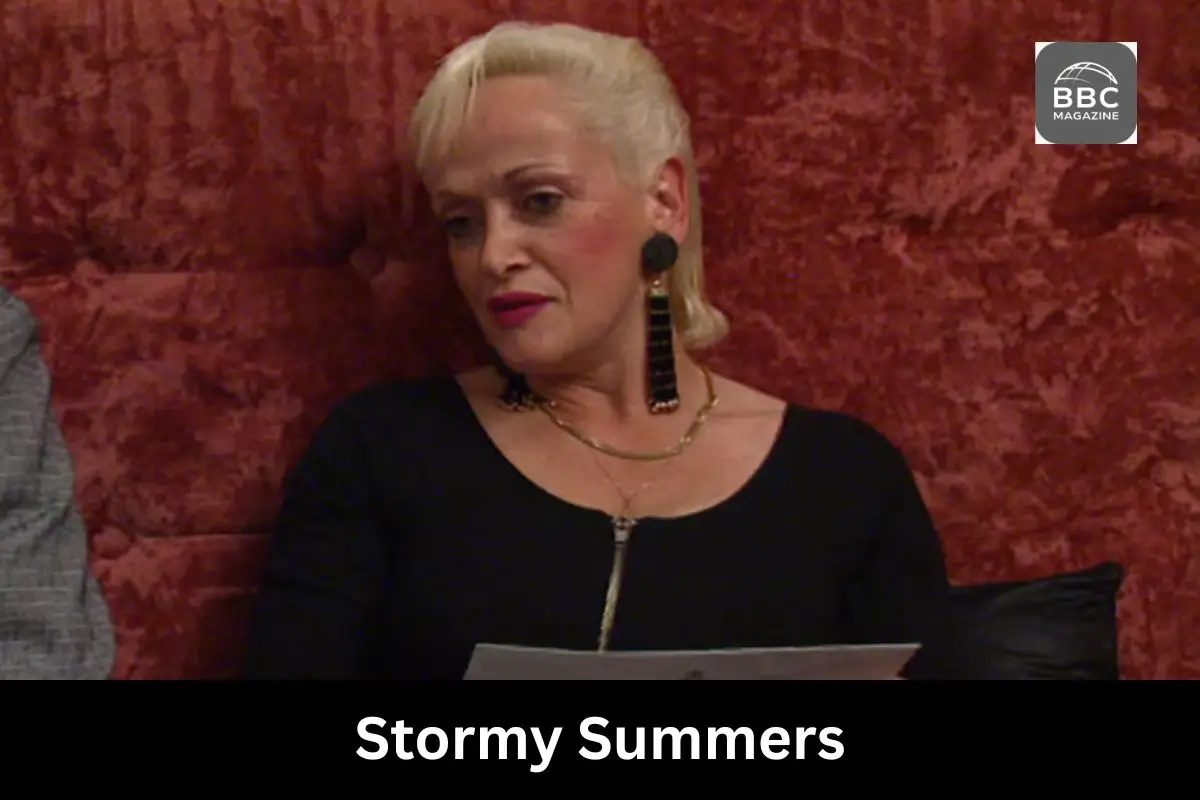

Stormy Summers occupied a space in Adelaide’s public life that was both conspicuous and uncomfortable. For decades, she forced issues into daylight that the city often preferred to keep at the margins. She was a business owner operating in a legally contested industry, a political agitator who challenged civic authority, and a media figure who understood how visibility itself could be a form of power. Her death in March 2024 prompted reflection not only on her life, but on the city she helped unsettle and, in doing so, reshape.
Stormy Summers was never a background presence. She lived publicly, argued loudly and rejected the notion that respectability required silence. While she divided opinion, she left an unmistakable imprint on Adelaide’s cultural and political conversation. This is a complete and verified account of her life, career, activism and death, drawn strictly from Australian reporting and public record, and written without speculation.
Death and final days
Stormy Summers died late on Sunday night, 17 March 2024, aged 77, at Lyell McEwin Hospital in Adelaide’s northern suburbs. The news was made public on Tuesday 19 March 2024, when South Australian media confirmed she had been unwell for a short period. No prolonged illness had been reported, and her death was widely described by friends as sudden.
No medical cause of death was released publicly. Neither her family nor close associates issued a formal statement detailing her condition, which aligned with Summers’ long-standing approach to personal privacy outside her public activism. Authorities did not indicate any suspicious circumstances surrounding her death.
Several outlets noted that Summers died only days before her 78th birthday, a detail that added to the shock felt by those who knew her. Despite the flamboyance that characterised much of her public life, her death occurred quietly, in hospital, without public spectacle.
Tributes followed swiftly across Adelaide media. Broadcasters, journalists and cultural commentators described her as vibrant, unforgettable and fiercely independent. Importantly, coverage framed her death not as a curiosity but as the loss of a significant Adelaide identity whose influence extended well beyond her industry.
A public identity shaped by intent
Stormy Summers did not drift into public attention. She constructed a public identity with deliberation. Long before she became a fixture of headlines and radio interviews, she adopted the name Stormy Summers as a permanent persona. The name itself signalled refusal: refusal of anonymity, refusal of apology, and refusal of the quiet respectability traditionally expected of women, particularly those operating in stigmatised industries.
She rarely spoke publicly about her early childhood, family background or education. Major Australian outlets have consistently noted the absence of verified details about her early life, including her exact date and place of birth, parents or schooling. This silence appears to have been intentional rather than accidental. Summers allowed her public life to begin where she chose, on her own terms.
This absence of early biographical detail became part of her mythos. Unlike many public figures, she did not seek legitimacy through origin stories. Her authority came instead from presence, persistence and confrontation.
Building a business at the centre of Adelaide
Stormy Summers was best known as the owner and operator of a long-running sex-work business in Adelaide’s central business district. Her most famous premises were located around Waymouth Street and Light Square, an area that placed her operation at the literal heart of the city.
She was explicit in rejecting the term “brothel”. Summers insisted on describing her establishment as a “boudoir”, arguing that language shaped both public perception and legal framing. This was not cosmetic branding. She believed that moral judgement was embedded in words, and she used terminology strategically to challenge stigma and assert dignity.
Her business, commonly known as Stormy’s, operated for decades. Summers was not a transient figure in the industry; she was a long-term employer who treated sex work as labour and business rather than secrecy. She repeatedly stated publicly that she paid taxes, even when aspects of the industry were legally contested, and commentators noted her emphasis on compliance and order.
Summers lived and worked in the same building for many years, including a penthouse apartment overlooking Light Square. This arrangement reflected her refusal to separate personal life from public advocacy. The city was not something she left at the end of the working day; it was where her identity unfolded continuously.
Journalists and visitors consistently remarked on the presentation of her premises. Accounts described strict cleanliness, control and internal discipline. Summers often highlighted these standards herself, using them to counter stereotypes about sex-work venues and to argue for regulation rather than criminalisation. While these descriptions come from testimony rather than regulatory audits, they form a consistent and well-documented part of her public defence.
Discipline behind the spectacle
Despite her flamboyant image, Summers was frequently described as disciplined, methodical and exacting in business. Friends and commentators recalled her attention to detail, punctuality and insistence on order. She understood legal frameworks deeply, even as she challenged them.
This contrast defined much of her public life. On the surface, she cultivated spectacle: dramatic clothing, sharp wit and confrontational language. Beneath that performance lay structure and control. Her defiance was not impulsive; it was calculated.
Summers understood that visibility carried risk, but she also understood that silence carried greater danger for those operating in criminalised spaces. Her approach was to remain seen, vocal and accountable on her own terms.
The 2006 Light Square standoff
One of the most dramatic episodes in Summers’ life occurred in 2006, when she barricaded herself inside her Light Square home and business following a rent dispute reportedly involving around $60,000. She had occupied the property for approximately 15 years and refused to vacate.
The situation escalated into a two-hour police standoff, attracting national as well as local media attention. Police eventually resolved the incident without serious injury, and no long-term charges resulted.
For supporters, the standoff symbolised resistance to eviction and authority, particularly against what Summers described as unjust treatment after years of occupation. For critics, it reinforced perceptions of volatility and theatrical confrontation. Regardless of interpretation, the event became a defining chapter in her public story and cemented her reputation as someone who would not withdraw quietly when challenged.
Entering civic politics
Stormy Summers’ most explicit entry into formal politics came in 2000, when she ran for Lord Mayor of Adelaide. The campaign was unprecedented and immediately polarising. A sex-work business owner standing for the city’s highest civic office forced Adelaide to confront issues it rarely discussed openly.
While sex-work law reform dominated headlines, Summers’ platform extended well beyond her own industry. She spoke publicly about homelessness in the city, arguing that visible poverty reflected policy failure rather than moral weakness. She advocated for drug rehabilitation services and supported practical responses to addiction rather than punitive ones.
Summers also emphasised the protection of Adelaide’s parklands, framing them as shared civic assets rather than political bargaining chips. Her campaign drew directly from her experience as a city resident and business operator, positioning her as someone grounded in daily urban realities.
She did not win the election, but the campaign achieved lasting impact. For the first time, sex-work law reform entered mainstream civic debate in Adelaide. Other candidates were forced to respond to questions they might otherwise have avoided. In this sense, Summers’ political influence extended beyond electoral success.
Advocacy for sex-work law reform
At the core of Stormy Summers’ public life was her sustained advocacy for the decriminalisation of sex work in South Australia. Long before the issue gained traction in parliament, she argued that criminalisation endangered workers, discouraged health oversight and entrenched exploitation.
Summers framed sex work as labour rather than morality. She rejected narratives that cast sex workers solely as victims, instead arguing for agency, safety and legal recognition. Her arguments anticipated many points now common in parliamentary debates, including transparency, workplace protections and harm reduction.
She was a frequent media commentator on these issues, appearing on radio and speaking to print journalists. Her willingness to speak publicly made her a lightning rod for criticism, but it also ensured the topic could not be ignored. Decades later, as South Australia continues to debate sex-work law reform, the relevance of her arguments remains clear.
Media presence and cultural standing
Stormy Summers maintained close relationships with figures in Adelaide’s media, arts and cultural communities. She was not merely reported on; she was engaged with. Radio broadcasters regularly invited her to speak because she was articulate, opinionated and unafraid of confrontation.
Former radio host Peter Goers, a long-time friend, described her as vibrant, loyal and generous. He recalled lavish gatherings at her Light Square penthouse and her ability to bring together people from different social worlds. Arts commentator Samela Harris described her as socially conscious, noting that her politics extended beyond sex-work reform to broader questions of social justice.
Adelaide media repeatedly referred to Summers as a “character”. This label reflected more than eccentricity. It signified someone who disrupted norms, challenged authority and embodied a counter-cultural tradition within a city often seen as cautious and conservative.
Lifestyle, performance and privacy
Stormy Summers lived theatrically. She understood the power of performance and used it deliberately. Her clothing, language and public presence were designed to command attention and control narrative.
At the same time, she guarded her private life closely. Despite decades of visibility, she revealed little about family relationships or personal history. Friends noted that this selective privacy was another form of control. Summers decided what would be seen and what would remain unknown.
She was also known for her affection for animals, particularly her poodles, which became part of her public image. These details, while light-hearted, contributed to the mythology that surrounded her and softened, for some, the confrontational edge of her persona.
Final farewell and community response
Stormy Summers’ funeral was well attended, reflecting her deep connections across Adelaide’s media, arts and activist communities. Attendees were invited to make donations to Hutt Street Centre, an organisation supporting people experiencing homelessness.
The choice of beneficiary reflected themes that had defined Summers’ public advocacy. She consistently argued that cities should be judged by how they treated their most marginalised residents, and her farewell echoed that belief.
Legacy and lasting influence
Stormy Summers leaves behind a legacy that resists simplification. She remains admired and criticised, celebrated and condemned, often simultaneously. Her influence was not legislative or institutional, but cultural.
She forced Adelaide to confront issues it preferred to keep hidden. She challenged assumptions about sex work, legality and morality. She demonstrated that visibility itself could be a political act.
The ongoing debate over sex-work decriminalisation in South Australia stands as an indirect testament to her impact. Arguments she made decades ago continue to shape contemporary discussion.
Stormy Summers lived loudly and deliberately. She changed the tone of public debate in Adelaide and left behind a city that, for better or worse, could no longer pretend certain conversations did not exist.
Conclusion
Stormy Summers did not fit easily into Adelaide’s idea of itself, and that was precisely her power. She lived in full view, refusing discretion where silence had long protected comfort and hypocrisy. Through business, activism and political confrontation, she challenged the boundaries of what could be said publicly in South Australia and who was permitted to say it.
Her influence was never about winning office or securing legislative victories. It lay in disruption. She forced sex work, homelessness, urban inequality and moral judgement into mainstream conversation at a time when these issues were routinely dismissed or hidden. By insisting on visibility, she altered how Adelaide talked about legality, dignity and responsibility.
Stormy Summers remains a polarising figure, and that tension is central to her legacy. She was neither a caricature nor a saint, but a complex individual who understood power, spectacle and resistance. Her death closes a chapter, but the debates she ignited continue, unresolved and necessary.
FAQs
Who was Stormy Summers?
Stormy Summers was an Adelaide brothel owner, public activist and political figure known for campaigning to decriminalise sex work and for her outspoken presence in South Australian public life.
When did Stormy Summers die?
Stormy Summers died late on Sunday night, 17 March 2024. Her death was publicly reported on Tuesday 19 March 2024.
How old was Stormy Summers when she died?
She was 77 years old at the time of her death, just days short of her 78th birthday.
Where did Stormy Summers die?
She died at Lyell McEwin Hospital in Adelaide’s northern suburbs after a short illness.
What was Stormy Summers known for in Adelaide?
She was widely known as a long-time brothel owner, political agitator and media figure who forced public debate on sex work, social justice and urban issues.
Did Stormy Summers run for political office?
Yes. She ran for Lord Mayor of Adelaide in 2000, using her campaign to raise issues such as sex-work law reform, homelessness and drug rehabilitation.
What happened during the 2006 Light Square standoff?
In 2006, Stormy Summers barricaded herself inside her Light Square home and business during a rent dispute, leading to a two-hour police standoff that attracted national attention.
What is Stormy Summers’ legacy in South Australia?
Her legacy lies in reshaping public discussion around sex work and social marginalisation, bringing previously taboo issues into mainstream civic and political debate.