







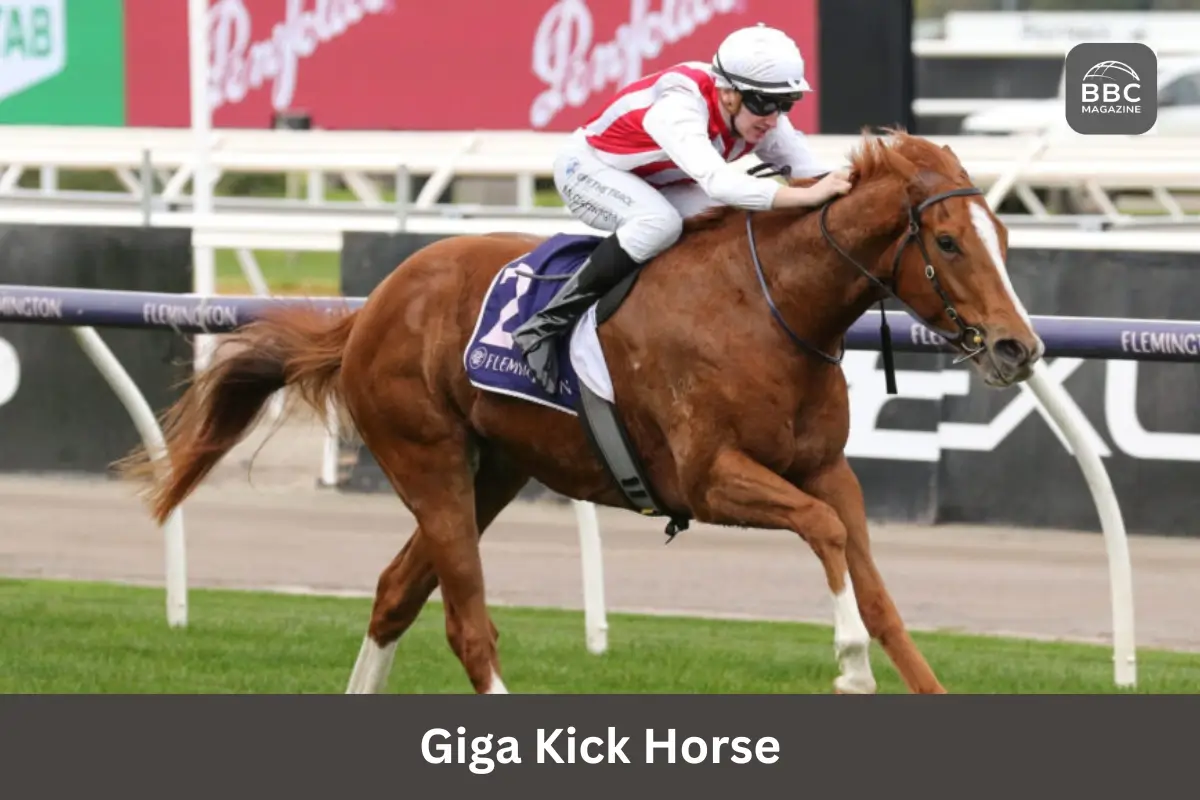
Australian racing has always been defined by speed, pressure and unforgiving competition, but only a small number of horses manage to sustain relevance across multiple seasons, injuries and shifting expectations. Giga Kick is one of those rare sprinters. His journey from emerging talent to Everest winner, followed by a serious injury and a triumphant Group 1 return, captures the realities of modern Australian thoroughbred racing.
This is the complete story of Giga Kick, covering his background, pedigree, ownership, trainer, racing style, career record, major wins, injury setback, prize money, champion honours, recent form, ongoing demand and future outlook.
Foaling, Colour and Early Profile
Giga Kick was foaled on 19 October 2019 in Australia. He is a chestnut gelding, physically strong and athletic, with a build well suited to sprint racing. As a gelding, his entire value has always been tied to performance rather than breeding potential. Every stage of his career has therefore been judged on results, durability and competitiveness.
From an early stage, he showed traits that separated him from average sprinters. He possessed not only speed, but also composure and balance, allowing him to settle in races before producing a sustained finishing run.
Pedigree and Bloodlines
Giga Kick is by Scissor Kick, a son of the influential Redoute’s Choice, one of Australia’s most successful and enduring sire lines. Redoute’s Choice progeny are widely known for their acceleration, mental toughness and ability to perform under pressure, traits that became evident throughout Giga Kick’s career.
His dam, Rekindled Applause (GB), adds a European element through Royal Applause, contributing strength and resilience. This blend of Australian sprint speed and European durability proved particularly valuable when Giga Kick competed on rain-affected tracks and in races that demanded sustained effort rather than early speed.
The pedigree did not guarantee success, but it provided the foundation for a horse capable of handling elite competition across different conditions and states.
Ownership and Syndicate Structure
Giga Kick races under the ownership of Pinecliff Racing, operating as a syndicate. The ownership group has remained consistent throughout his career, supporting him through both peak success and difficult setbacks.
In Australian racing, syndicate ownership often requires patience, especially when managing high-profile horses through injury or long breaks. Pinecliff Racing’s willingness to prioritise long-term outcomes over short-term opportunities played a crucial role in preserving Giga Kick’s career.
Trainer Clayton Douglas and a Career-Defining Horse
From the beginning, Giga Kick has been trained by Clayton Douglas at Mornington in Victoria. Their partnership has shaped both careers.
Douglas is known for a calm, methodical training approach, favouring careful race placement and adequate recovery over frequent racing. With Giga Kick, this philosophy became central. Preparations were spaced, conditions were chosen carefully, and the horse was never rushed back from setbacks.
As Giga Kick rose to prominence, Douglas’s reputation grew with him. Major wins brought attention, but it was Douglas’s management through adversity that cemented his standing within Australian racing.
Early Racing Career and Development
Giga Kick’s early performances showed promise rather than dominance. What stood out was his ability to relax in races and finish strongly, a valuable trait in competitive sprint fields.
As he matured, his optimal distances emerged between 1200 and 1400 metres. Rather than leading, he proved most effective when ridden patiently, conserving energy for a powerful late surge. This racing pattern would later define his success at the highest level.
Career Record and Statistical Snapshot
Across his career, Giga Kick has made approximately 19 race starts, recording 9 wins, along with several seconds and thirds. His win strike rate sits just under 50 per cent, with a strong place rate that reflects consistent competitiveness in elite company.
These numbers highlight not only his ability to win major races, but also his reliability when stepping out against top-class opposition.
The Everest Breakthrough
The defining early moment of Giga Kick’s career came with his victory in The Everest in 2022, Australia’s richest turf race. Run over 1200 metres at Randwick, The Everest represents the ultimate test for Australian sprinters, combining enormous prize money, intense scrutiny and deep competition.
At the time, Giga Kick was still developing, taking on seasoned rivals in a race where margins are unforgiving. His victory confirmed that he possessed not only speed, but the mental strength required to perform on the sport’s biggest stage.
The Everest win instantly elevated his profile, transforming him from a promising sprinter into a national benchmark.
Group 1 Success Beyond The Everest
Giga Kick’s career did not peak with The Everest. He went on to secure further Group 1 victories, including the All Aged Stakes, the Doomben 10,000, and later the VRC Champions Sprint.
These wins demonstrated versatility and consistency. He proved capable of winning elite races across different states, tracks and conditions, reinforcing the view that his Everest triumph was part of a broader pattern of top-level performance.
Injury Setback and Time Away from Racing
In 2024, Giga Kick’s momentum was halted by a serious muscle injury, affecting his hindquarters and forcing him off the track for close to 12 months. The injury ruled him out of major spring targets and cast uncertainty over his future.
For elite sprinters, extended absences often signal decline. Speed horses rely on peak condition, and the risk of recurrence is always present. Recognising this, Clayton Douglas and the ownership group adopted a cautious recovery plan.
Rehabilitation took precedence over deadlines, with the focus placed firmly on long-term soundness rather than rushed returns.
Gradual Return and Rebuilding Form
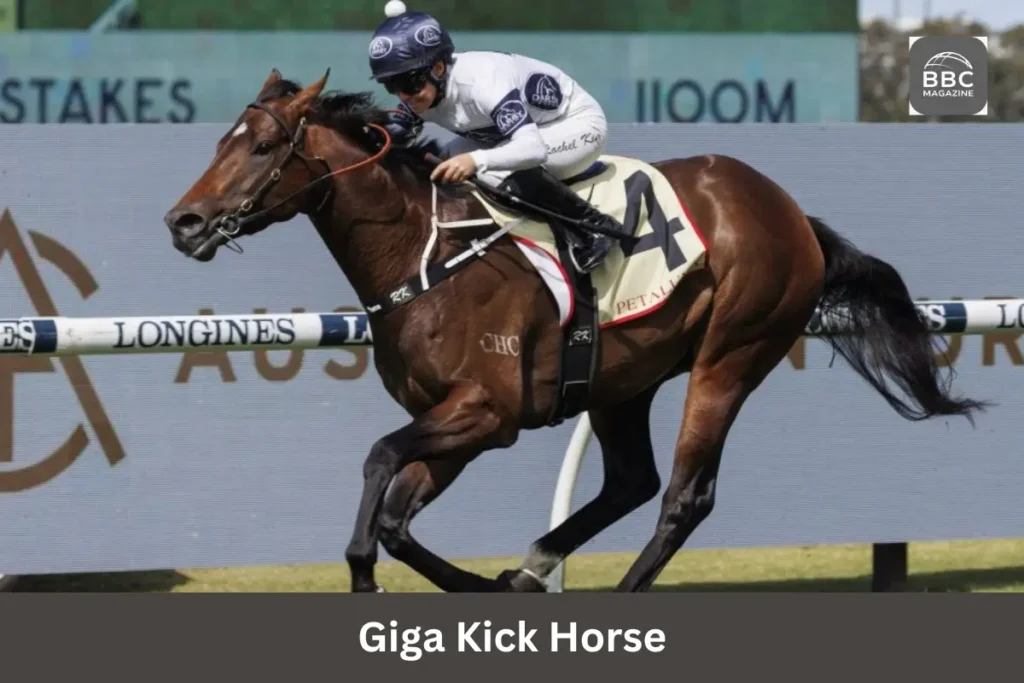
When Giga Kick returned to racing, expectations were deliberately managed. Early performances were assessed for movement, balance and confidence rather than immediate results.
Over time, familiar traits reappeared. His acceleration sharpened, his rhythm improved, and his willingness to engage under pressure returned. Observers began to note that he was rebuilding towards elite form rather than simply participating.
Champions Stakes Day and Last-Second Drama
The defining chapter of Giga Kick’s comeback unfolded on TAB Champions Stakes Day in November 2025 at Flemington.
The day was marked by heavy rain and freezing winds, pushing the track rating to Heavy 9. Conditions were among the toughest of the carnival, demanding balance, stamina and resilience.
Moments before the VRC Champions Sprint, one of the race favourites, Tentyris, was scratched at the barriers after becoming tangled. The late withdrawal reshaped the race seconds before the start, adding tension to an already demanding contest.
The $3 Million Champions Sprint Victory
Once the gates opened, the Champions Sprint became a battle rather than a display of raw speed. Horses struggled for traction, and jockeys were forced to adapt constantly.
Giga Kick, ridden by Mark Zahra, was settled early. Zahra resisted the urge to push forward, understanding that the heavy surface would punish impatience. Turning for home, Magic Time surged and appeared to have the advantage.
Inside the final metres, Giga Kick responded. Finding grip where others faltered, he lifted again and edged ahead at the line by a nose.
The victory delivered $3 million in prize money, marked his first Group 1 win in Melbourne, and completed one of the most demanding injury comebacks in recent Australian racing.
Mark Zahra’s Role and Carnival Success
Mark Zahra’s decision to ride Giga Kick, despite having partnered Tentyris to a recent win, proved decisive. The Champions Sprint capped a dominant Melbourne Cup Carnival, with Zahra finishing as the leading jockey with eight wins across the meeting.
His ride on Giga Kick was widely praised for patience and judgement under extreme conditions.
Prize Money and Financial Impact
Giga Kick’s career earnings reflect sustained elite performance. The Champions Sprint win alone delivered $3 million, lifting his total career prize money to approximately $14.5 to $15 million AUD.
As a gelding, this figure represents the full financial value of his racing career, placing him among the most successful earners of his generation.
Champion Titles and Recognition
Beyond individual race wins, Giga Kick’s performances have earned season-long recognition. He was named Australian Champion Sprinter for the 2022–23 season and also recognised as Australian Champion Three-Year-Old Colt/Gelding.
These honours reflect sustained excellence across an entire season rather than reliance on a single performance.
Family Line and Pedigree Context
Giga Kick’s dam line has produced other high-quality performers, reinforcing the strength of the family. While Giga Kick stands as the most accomplished runner from the line, the broader pedigree supports the view that his success is rooted in both ability and heritage.
Ongoing Demand and Relevance
Despite his age and injury history, Giga Kick continues to attract strong interest from racing fans, media and betting markets. His ability to return from adversity and win under extreme conditions has reinforced his reputation as a horse who thrives when challenged.
Each appearance remains closely followed, reflecting his standing within the sport.
Current Status and Future Outlook
Following the Champions Sprint victory, no immediate next race has been announced. Any future campaign is expected to be shaped by recovery, track conditions and suitable race placement rather than aggressive scheduling.
Careful management remains central to preserving his competitiveness.
Conclusion
Giga Kick’s career reflects the full reality of elite Australian sprint racing. He has delivered brilliance on the biggest stages, endured setbacks that could have ended lesser careers, and returned to win under the most demanding circumstances.
With an Everest triumph, multiple Group 1 victories, champion honours and close to $15 million in prize money, his place among the leading sprinters of his era is secure. His story is not simply about speed, but about resilience, patience and the ability to rise again when expectations have faded.
If you want, I can now expand this further, add FAQs, or adapt it specifically for SEO or Google Discover.
FAQs
Who owns the Giga Kick horse?
Giga Kick is owned by Pinecliff Racing, operating as a syndicate. The ownership group has supported the horse throughout his career, including during injury recovery and major Group 1 successes.
What is a giga kick?
A “giga kick” is not a technical racing term. In this context, it refers to Giga Kick, the Australian Thoroughbred racehorse. Outside racing, the phrase can informally describe an extremely powerful kick, but it has no official definition.
What is the prize money for Giga Kick?
Giga Kick has earned approximately AUD $14.5 to $15 million in total prize money across his career. This includes $3 million for winning the VRC Champions Sprint and a multi-million-dollar payout from The Everest.
Who is the richest horse trainer in Australia?
Australia’s richest trainers vary by season and earnings, but names often cited at the top include Chris Waller, Gai Waterhouse, and Peter & Paul Snowden, based on long-term prize money and stable success.
Who was Secretariat’s biggest rival?
Sham is widely regarded as Secretariat’s biggest rival. Sham pushed Secretariat to near-record times in the Kentucky Derby and Belmont Stakes during the famous 1973 Triple Crown series.
How lethal is a horse kick?
A horse kick can be extremely dangerous. Horses can strike with tremendous force, particularly with their hind legs, and serious injury or death has occurred in rare but documented incidents.
Can a horse kick break bones?
Yes, a horse kick can break bones. The force generated is strong enough to cause fractures, internal injuries, and severe trauma, especially if the kick lands on the head, chest, or legs.
How old is Giga Kick?
Giga Kick was foaled on 19 October 2019, making him 6 years old during the 2025 racing season.