





Tom Mitchell’s journey in the AFL has never been linear. From early promise at Sydney to dominance at Hawthorn, from a shattered leg to a Brownlow Medal, and from premiership success at Collingwood to the most uncertain phase of his professional life, Mitchell’s story is defined by endurance rather than comfort. His most recent battle was not solely against form, age, or selection politics, but rather against a series of foot injuries that threatened to end his career entirely.
Between 2024 and 2025, Mitchell endured one of the most mentally draining injury runs seen in modern AFL football. It was not a single dramatic incident but a sequence of breakdowns, recoveries, and setbacks that removed certainty from every step forward. By the time he returned to senior football, he was no longer simply chasing form. He was fighting to remain relevant, available, and trusted.
Early Career and Rise in the AFL System
The Sydney Swans drafted Tom Mitchell in 2010 as a father-son selection, inheriting his father Greg Mitchell’s legacy. Patience, rather than immediate opportunity, shaped his early years as he worked his way into a strong Swans midfield that included established stars.
His move to Hawthorn in 2016 changed everything. Given midfield responsibility, Mitchell became one of the most prolific ball winners the game has seen. His ability to find space at stoppages, absorb contact, and distribute by hand or foot turned him into a statistical force. In 2018, he won the Brownlow Medal after averaging nearly 36 disposals a game, cementing his status as one of the competition’s elite midfielders.
That rise was interrupted in 2019 by a horrific double leg break, an injury that sidelined him for an entire season and forced the first major reset of his career. He returned, rebuilt his game, and later moved to Collingwood, where he added a premiership medal in 2023 and finished fourth in the Copeland Trophy in his first season at the club.
A Career Built on repeated efforts
Mitchell’s game has always been physically demanding. Unlike outside runners who rely on speed and space, his value lies in contested situations. He thrives in traffic, takes contact, and produces repeat efforts across four quarters. That style brings reward, but it also places a relentless load on the lower body, particularly the feet.
As Mitchell entered his thirties, the accumulation of that load became harder to manage. While his output remained strong, the margin for error narrowed. When the foot issues began in 2024, they struck at the most vulnerable point of his playing profile.
The First Breakdown: Plantar Fascia Tear
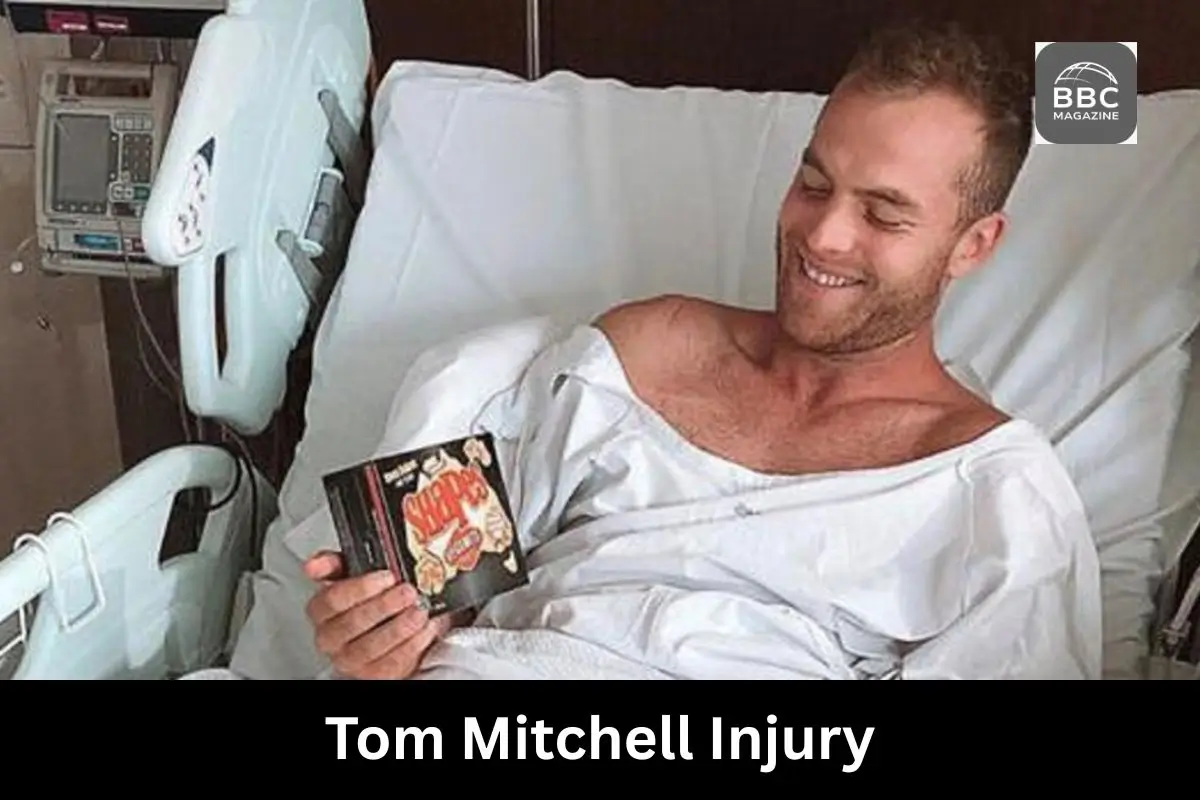
The initial signs appeared early in the 2024 season. Mitchell began experiencing persistent foot pain that failed to settle with reduced loads. What may have seemed manageable at first gradually worsened until a medical assessment confirmed a tear to the plantar fascia.
The plantar fascia is a thick band of tissue running along the underside of the foot, supporting the arch and absorbing force with every step. For an AFL midfielder, it is under constant strain. Sprinting, decelerating, pivoting at stoppages, and absorbing contact all place stress on this structure.
Mitchell attempted to manage the injury conservatively, but the pain persisted. He played his last game of the season before Anzac Day 2024. From that point on, the focus shifted from weekly selection to long-term damage control.
Surgery and a Lost Season
By June 2024, surgery had become unavoidable. Nonsurgical treatment had failed to resolve the issue, and continuing without intervention risked permanent damage. The procedure ended any chance of a return that season and began a long rehabilitation process with no guarantees attached.
For Mitchell, the surgery was not just about recovery. It marked the beginning of uncertainty. At 31, coming off a major foot operation, questions naturally followed about durability, workload tolerance, and future role.
The False Dawn of Recovery
Rehabilitation progressed steadily through the second half of 2024. By the end of the year, Mitchell had rejoined full training and appeared ready to reset for the following season. Structurally, the plantar fascia had healed. From the outside, the worst seemed to be over.
Internally, however, the foot had not yet adapted to elite demands. Just one week after returning to the main training group in December 2024, Mitchell experienced renewed soreness. Scans confirmed a mild stress injury to the second metatarsal bone in the same foot.
This moment became the most pivotal of the entire injury saga.
Bone Stress Injury and Load Failure
The second metatarsal plays a critical role in weight-bearing propulsion. Bone stress injuries do not occur suddenly. They develop when bone remodelling cannot keep pace with repetitive load. In Mitchell’s case, the injury suggested the foot was still struggling to cope with AFL training intensity.
Although described as mild, the implications were serious. It meant the foot was not yet capable of handling even controlled increases in workload. Mitchell was placed in a boot, impact loading was removed, and his pre-season was once again derailed.
This setback confirmed that recovery was not linear. Each step forward carried the risk of regression.
The Psychological Toll of 435 Days Out
Mitchell later described this period as more mentally demanding than his 2019 double leg break. That injury, while severe, came with clarity. This one did not.
From Anzac Day 2024 to mid-2025, Mitchell went 435 days between AFL games. During that time, he dealt with repeated setbacks, fluctuating timelines, and constant reassessment. Each scan became a source of anxiety. Each return to training carried doubt.
The uncertainty was exhausting. Progress could not be trusted. Confidence had to be rebuilt repeatedly.
Extreme Commitment to Survival
Recognising that his career was entering its final phase, Mitchell completely changed his approach. Standard rehabilitation was no longer enough.
He installed a sauna and ice bath at home to allow daily recovery beyond club requirements. Acupuncture focused on his feet and ankles became a weekly routine. Additional massage sessions and independent mobility work filled the gaps around club training.
Most importantly, Mitchell committed to Dynamic Neuromuscular training with renowned movement coach Mark McGrath. DNS focuses on improving posture, breathing, joint alignment, and efficient movement patterns. and efficient movement patterns. and efficient movement patterns. For Mitchell, it was about redistributing the load away from vulnerable areas and preventing further breakdown.
His goal was not about optimisation or marginal gains. It was about staying in the game.
Return Through the VFL.
Mitchell’s return to football came through the VFL in May 2025. This phase was cautious by design. Minutes were managed, loads monitored, and recovery responses assessed closely.
The aim was not to dominate. It was to prove durability. Only once the foot demonstrated tolerance to repeated match conditions did senior selection become realistic again.
Back at AFL Level Under Management
Mitchell eventually returned to AFL football later in 2025. When he did, his skill remained evident. He found the ball, used it efficiently, and contributed at stoppages. In one standout performance against Richmond, he collected 29 disposals at high efficiency, showing that the football brain and hands had not deserted him.
Yet the conditions of his return were different. He was managed in and out of games. Training loads were controlled. Recovery routines became non-negotiable. The result was not a return to normality. It was a negotiated continuation.
Selection Pressure and Changing Roles
During Mitchell’s absence, Collingwood’s midfield evolved. Younger players established roles, and availability became as important as output. Despite his résumé, Mitchell understood that selection was no longer guaranteed.
Competition from players such as Nick Daicos, Scott Pendlebury, Jordan De Goey, and emerging midfielders meant every appearance mattered. Past performances offered no protection.
Latest Career Context and Future Outlook
By late 2025, Mitchell found himself without a contract beyond the season. Despite returning to play, Collingwood ultimately chose not to extend his deal, reflecting the reality of list management, age, and injury history.
Mitchell has remained open about his desire to continue playing in 2026, whether at Collingwood or elsewhere. He has spoken publicly about feeling physically capable while acknowledging that opportunities are limited and competition fierce.
Alongside this, Mitchell has expanded his media presence, appearing on Channel 7, 3AW radio, and through his Ball Magnets podcast. These moves suggest a player preparing for life beyond football while still fighting to remain part of it.
Playing Career Overview
Tom Mitchell has played AFL football for Sydney, Hawthorn, and Collingwood. Throughout his career, he has been recognised as one of the most prolific midfielders in his generation. His honours include the Brownlow Medal, multiple All-Australian selections, club best and fairest awards, and a premiership medal.
His career has spanned more than a decade at the highest level, marked by elite performance, severe injury, and repeated reinvention.
Net Worth and Financial Standing
Mitchell, a longtime AFL midfielder and Brownlow medallist, has earned significant income throughout his career. While exact figures are private, estimates place his net worth in the range of several million dollars. This reflects years of AFL contracts, endorsements, and post-career media ventures.
Despite his financial security, Mitchell has consistently emphasised that his motivation is competitive rather than monetary. His decision to invest heavily in recovery and preparation underscores a desire to play on, not simply transition away.
Conclusion
Tom Mitchell’s recent injury battle was not a setback. It was a reckoning. The plantar fascia tear and subsequent bone stress injury stripped away certainty, rhythm, and security at the most vulnerable point of his career.
He did not lose his talent. He lost time, margin for error, and the comfort of expectation. What remains is a player who understands his body better than ever and knows that every game must now be earned.
In an AFL system that moves quickly and rewards availability, Mitchell’s fight to return stands as a reminder that survival at the elite level often requires more than skill. It requires acceptance, adaptation, and an unwillingness to let uncertainty decide the ending.
FAQs: Tom Mitchell Injury and Career
What injury did Tom Mitchell suffer at Collingwood?
Tom Mitchell suffered a plantar fascia tear in his foot during the 2024 season, followed by a stress injury to his second metatarsal bone in December 2024 after returning to training.
When did Tom Mitchell last play AFL before his long injury layoff?
Mitchell last played AFL football before his injury layoff on Anzac Day in 2024 and did not return to the senior level until mid-2025.
How long was Tom Mitchell out of AFL football?
Tom Mitchell spent 435 days between AFL games due to ongoing foot injuries, surgery, rehabilitation setbacks, and a delayed return through the VFL.
Why was Tom Mitchell’s foot injury considered serious?
Foot injuries affect balance, acceleration, and endurance, all central to Mitchell’s inside-midfield role, making recovery uncertain and increasing the risk of recurrence.
Did Tom Mitchell require surgery for his injury?
Yes, Mitchell underwent foot surgery in June 2024 after conservative treatment for his plantar fascia injury failed to resolve ongoing pain.
How did Tom Mitchell return to football after injury?
Mitchell returned via the VFL in May 2025, with carefully managed minutes and training loads before re-entering AFL selection later in the season.
Is Tom Mitchell still playing AFL football?
Tom Mitchell returned to senior AFL football in 2025 but finished the season without a contract, leaving his playing future beyond 2025 uncertain.
What is Tom Mitchell doing alongside his playing career?
Alongside football, Mitchell has increased his media work, including radio appearances, television commentary, and his Ball Magnets podcast, while aiming to play on in 2026.